Optimization vs. engagement in the age of AI search
Today's Drama
LinkedIn recently shared research based on 9.5 million AI citations showing that, across the B2B categories studied, LinkedIn was the #2 most-cited source, behind only YouTube.
That's a pretty big deal for thought leadership and another reminder that AI is reshaping how expertise gets discovered.
My First Thought
"Lovely...so are we writing for AI or for actual people?"
What Actually Matters
The more we optimize for AI citations, the more we risk creating content that humans scroll right past. If everyone starts writing for the algorithm, what happens to engagement?
The Centric Take
Optimization gets you discovered. Engagement earns trust. If your content only satisfies AI, you'll be found but forgotten. If it only satisfies humans, you may miss opportunities to be discovered.
The future belongs to businesses that can do both.
I've been having this conversation a lot lately.
Marketing has always been about knowing your audience. The challenge now is that we suddenly have two audiences: humans and AI.
On one side, you want your expertise cited by AI search engines and LLMs. Being referenced by ChatGPT, Gemini, Copilot or Perplexity isn't just an ego boost anymore. It's becoming another form of visibility. The easier your expertise is for AI to understand, the more opportunity there is for it to surface your business.
On the other hand, humans haven't changed nearly as much.
People still want authenticity. They still skim. They still make snap judgments. And in a world flooded with AI-generated content, certain formatting patterns—perfect bullet lists, repetitive sentence structures, overly polished transitions, suspiciously tidy line breaks and, yes, the em dash — (see the irony)—have become visual cues that make some readers question whether a person actually wrote what they're reading.
That's the tension that caught my attention while reading LinkedIn's research.
The article celebrates LinkedIn becoming the second-most cited source in the B2B categories studied, which is fantastic news for professionals and B2B marketers. It validates that expertise shared on the platform is influencing AI-generated answers.
Yay!
But it made me ask a different question:
Have we placed a higher value on AI optimization at the expense of human engagement?
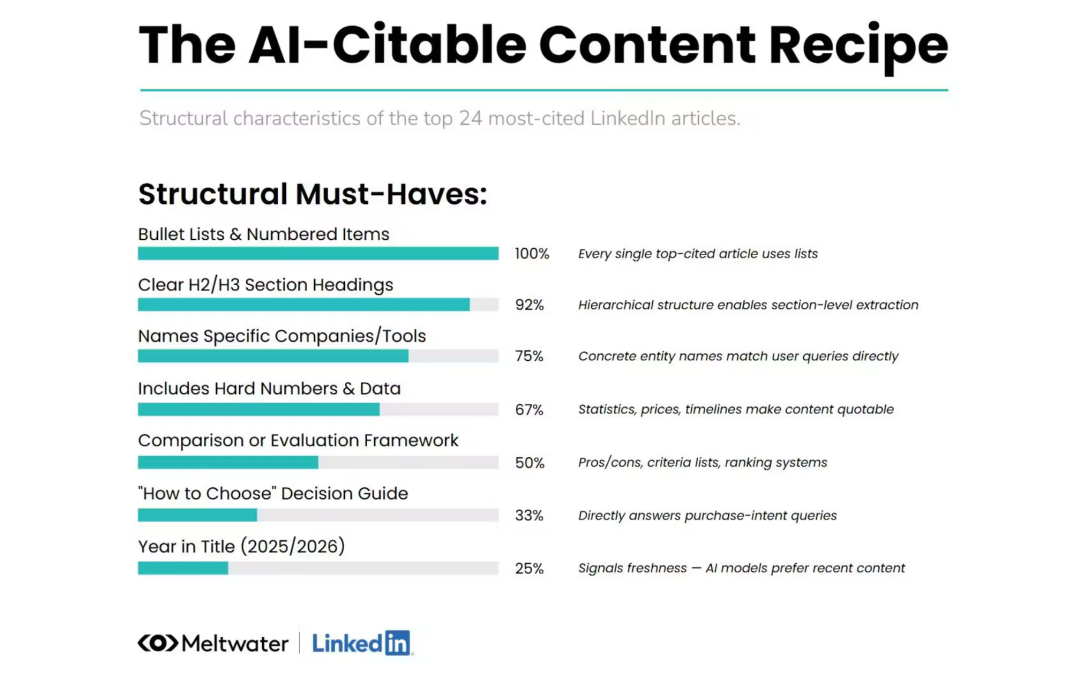
One of the recommendations highlighted in the research is that highly cited content tends to be structured, including lists and how-to content.
Ironically, less than twelve hours before reading the article, I had a conversation with a small business owner who told me they intentionally skip posts with certain formatting—particularly bullet-heavy posts and excessive line breaks—because they assume the content is AI-generated.
Now, that's one person. It's certainly not a statistically significant sample size.
But marketers don't get to ignore perception simply because it isn't universal.
If enough people begin associating certain writing styles with "fake" or "AI," then that perception becomes part of the user experience. And perception influences behavior, trust and engagement.
That's what fascinates me about where marketing is headed.
For years, we optimized for search engines. Now we're optimizing for AI models. The risk is becoming so focused on being machine-readable that we stop being human-readable.
And here's where I think marketers need to be careful.
We're hearing a lot about AI visibility, citations, impressions, traffic and the incredible reach businesses are achieving by adapting their content.
Great.
But did it convert?
Did the content bring in the right people?
Was it strong enough, relatable enough and human enough that someone actually trusted the business after they found it?
Because traffic and visibility are only pieces of the marketing puzzle. Being cited doesn't automatically mean being chosen.
So maybe the question isn't whether we should write for AI or humans. We have to write for both.
AI needs enough clarity and structure to understand your expertise.
Humans need enough personality, experience, originality and imperfection to believe there is an actual person behind it.
Make your human expertise legible to AI. Don't make your expertise sound like AI.
That's the distinction.
AI may introduce someone to your business.
But your content, your voice and your expertise have to convince them to stay.
And in most cases, AI isn't the one buying from you.
A human is.
The Centric Take
Optimization should make your expertise easier to find, not harder to trust.
AI can influence the structure. Strategy should determine the message.
Don't confuse being cited with being chosen.
Human first. AI understood.
-Violet
*Personal Disclaimer*
I had a hard time writing this debrief without cringing a little myself.
The formatting. The line breaks. The complete-but-somehow-incomplete sentences. My 7th-grade English Lit teacher would have red marks all over this thing. So, I completely understand the hesitation.
But I also believe there's a difference between blindly following what AI tells us works and being willing to step outside our comfort zone when something can genuinely help our businesses grow and better serve our audiences.
That's the strategy I'm interested in.
How do we embrace what AI can do for visibility and optimization without sacrificing the voice, credibility and human connection that actually make someone choose you?
If you're wrestling with that too, let's have the conversation. We can figure out where AI belongs in your marketing strategy and, just as importantly, where it doesn't.
Because the goal isn't to make your marketing look like AI. It's to make AI work harder for your marketing.